
The Hidden Data Inside a Child’s Play
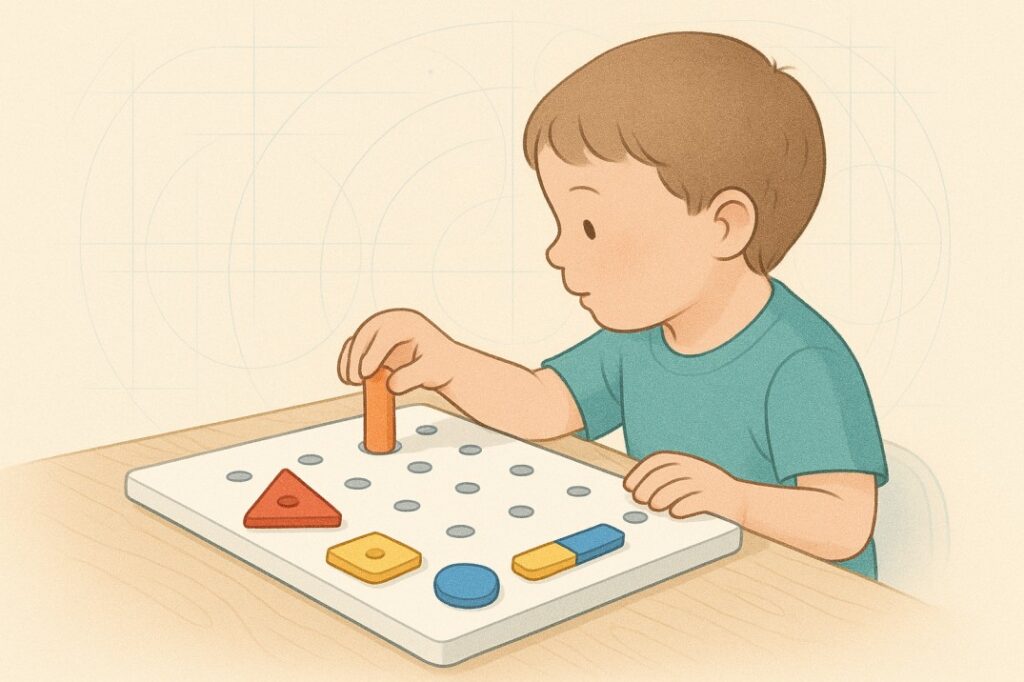
By the standards of adult measurement, play is often dismissed as idly joyful — sticky fingers, half-built towers, fleeting giggles. But beneath those bright, apparently chaotic minutes there is structure, pattern, and a ledger of learning. If we listen closely to how a child manipulates objects, swaps pieces, and returns to a favored action, we can read a kind of data: what a child notices, resists, repeats, and invents. That data is not rows of numbers; it’s a narrative of emerging cognition.
This essay looks at play the way a careful scientist might approach a living dataset — not to extract profit or to instrumentalize a child, but to honour and better support the intelligence already at work. It borrows from a child-first philosophy (what ABC Genie calls “child-as-symbolic-stakeholder”) to argue that the most useful reading of play is one that preserves the child’s dignity while revealing signals adults can use to design kinder, clearer learning experiences.
Play as active sensing
Children do not merely move objects; they probe possibilities. They learn the affordances of materials (what bends, what stacks, what clings), they experiment with sequence (put this before that), and they test social rules (who gets the peg, who laughs when the block falls). Each of these tiny experiments produces reliable signals: patterns of attention, motor control, language attempts, and affect.
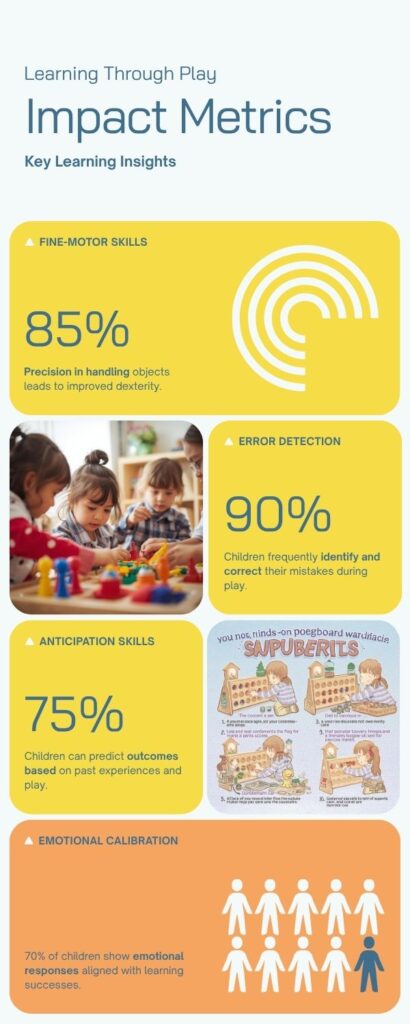
Consider a small, repeatable episode: a child places a peg into a hole, feels resistance, adjusts angle, succeeds, and then smiles. In that loop are at least four measurable things: fine-motor precision, error-detection and correction, anticipation of outcome, and emotional calibration. Observe enough iterations across contexts and you have a profile of a child’s current capacities and the learning edges where instruction or scaffolding could be gentle and meaningful.
Reading material design as data amplifier
Physical learning tools are not neutral. Their shape, weight, and response influence what children attend to and therefore what they learn. A recent internal specification for a child-oriented foundation pad and interchangeable language layers — a modular board with magnetic pegs and cutouts — makes this point plainly: material choices (magnet strength, peg size, layer geometry) create constraints that invite particular behaviours and block others. The design intentionally couples pegs to a hidden magnetic sheet so pegs stay in place even when the pad is tilted, and includes a whiteboard surface and storage compartment to support switching activities quickly. These are not convenience features; they shape the sequence, frequency, and type of interactions a child will perform.
When designers recognize that their product encodes a set of possible actions, they can treat the product as an amplifier of useful data. For example: if a peg requires a two-step insertion (align, press), the child’s attempts reveal both alignment skill and force control; if letters are color-coded, misplacements reveal letter recognition gaps separate from motor mistakes. Good design reduces ambiguous error signals and makes the “why” of failure legible.
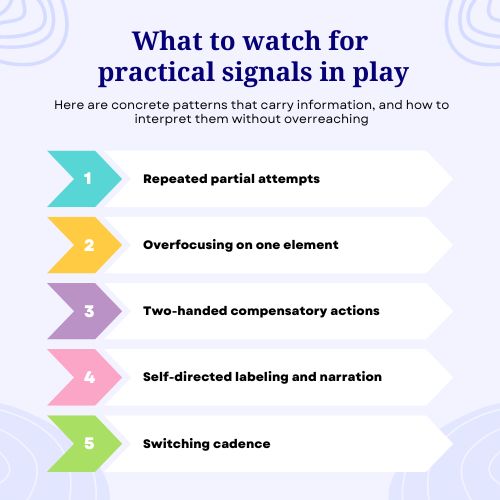
What to watch for — practical signals in play
Here are concrete patterns that carry information, and how to interpret them without overreaching:
- Repeated partial attempts: The child repeatedly starts a sequence but stops. Possible interpretation: planning or working-memory limit, or a missing affordance (piece doesn’t fit easily). Response: simplify the step or provide a visual cue rather than simply doing it for them.
- Overfocusing on one element: When a child plays with the same peg or shape for long stretches, they may be exploring a property (weight, texture) or avoiding social risk. Interpret gently: ask an open question about what they’re discovering; offer related materials to scaffold extension.
- Two-handed compensatory actions: Using both hands for a task that typically needs one suggests either an immature motor plan or deliberate bilateral strategy. Track whether this is transient — many children use two hands while developing fine motor precision.
- Self-directed labeling and narration: When a child names or narrates their play, we see language scaffolding in real time. These utterances are highly informative about vocabulary and conceptual grasp.
- Switching cadence: Rapid switching between activities can mean boredom or over-stimulation; very slow, perseverative play can indicate deep exploration or a need for subtle support. Context matters — what preceded the behaviour, who else is present, and whether the child seems joyful or frustrated.
Reading these signals well requires longitudinal attention. Is the child showing the pattern consistently? Has the environment changed? Data in isolation misleads; patterns across days and contexts reveal the learning trajectory.
Ethics and the child-first ledger
Treating play as data raises ethical questions. The first guiding principle should be: preserve agency. Observing to support learning is fundamentally different from surveilling to control. The child-first philosophy insists that any data inference must serve the child’s flourishing and that adults remain transparent and respectful.
Practically: record observations as questions rather than verdicts. Avoid turning a child into a checklist. Use what you learn to create invitations — new materials, slight modifications to rules, or prompts that honour curiosity rather than correct it prematurely.
There’s also a material humility: tools that capture signals should be designed to be forgiving. For instance, a magnetic peg system that prevents accidental loss and reduces frustration is an ethical design choice. The technical details matter precisely because they affect who succeeds and who gets discouraged. The Foundation Pad design mentioned earlier embeds a metallic plate to ensure pegs couple reliably through layers, and includes a whiteboard base and storage to reduce friction between activities — small design choices that protect the child’s flow and preserve clearer data about competence rather than about nuisance failures.
From observation to kinder intervention
Once adults cultivate attentive, ethical observation, the next step is to act in ways that broaden play’s possibilities:
- Scaffold minimally: Offer a hint or a model once, then step back. Children consolidate learning by attempting after a brief demonstration.
- Adjust materials, not meaning: If children struggle because a peg is too stiff or a cutout is ambiguous, change the material affordance rather than the learning goal.
- Translate patterns into invitations: If a child repeatedly stacks objects vertically, invite them to experiment with balance by providing a baseplate; if they enjoy lining things up, prompt counting or storytelling.
- Value meta-play: Conversations about play — “What are you trying to do?” — build metacognition. Children who learn to talk about their play gain tools for planning and reflection.
The politics of small actions
At scale, this attention to play reframes early education policy. If curriculum and procurement privilege tools that obscure child effort (single-use worksheets, devices that auto-complete tasks), we risk training children to accept immediate answers rather than the process of discovery. Conversely, when materials are intentionally designed to make success legible and failure instructive, classrooms become laboratories of gentle experimentation.
This does not mean technology must be present in glittering form. Often the richest data lives in low-tech gestures: how a child lines up cups, how they insist a puppet speak in a shy voice, how they return to a puzzle after a break. Design and policy should amplify those gestures, not drown them.
Listen to the small ledger
If we reconceive play as a live, humane dataset — one that records attempts, surprises, and micro-corrections — then adults gain not a tool for scoring children but a map for supporting them. The best readings of that map keep the child central: observing to understand, designing to enable, and intervening to expand possibility.
The hidden data inside a child’s play is generous. It tells us where a child is competent, where they are curious, and where a small nudge can open a new horizon. Read it with patience, translate it into kinder environments, and you will find that the rest — language, logic, social grace — often follows in the wake of a well-supported, well-seen play.
